| |
 |
|
|
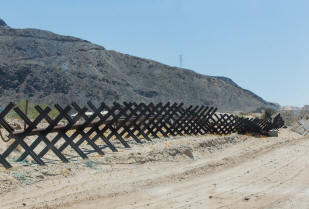
The biggest concern we have
now is getting a border wall across our complete
state. Hundreds of miles are only protected by
these X barriers, which as you can see
offer no protection against simply walking
across the border.
All in all, encouraging legal
immigration, enforcing laws against illegal
entry, protecting our borders, and our Border
Patrol officers, is a huge priority to those of
us that live here.
|
|
|
As a citizen of
Columbus New Mexico (A port of entry border
town with
Palomas Mexico) I can tell you border security has
been tremendously beefed up in recent years. In fact, we
just opened a brand new, state of the art, Port of Entry
facility. The U.S. Government calling it the
finest POE facility ever built in the United States.
Over the last 20 years we have seen the tide
change from illegal immigrants literally walking through
our town everyday on their way up to Interstate 10, to
virtually no sign of them at all.
What we see now are
large numbers of Border Patrol trucks, agents, quad
runners, and the buzz-by of their helicopters. This is a
major shift, back in the hay day, housing the illegal
traffic for a a day or two was a cottage industry in our
small village for those who had a spare room or shelter.
Having married a Mexican
citizen, I can tell you the process of getting
her residency was a bit of a muddle, but with
patience, and the understanding that in these
parts of country (El Paso corridor), the
Immigration and Naturalization agency has their
hands full. All in all we accomplished the task
in relatively short order. We then went on to
getting her citizenship. The whole process took
about 5 years. |
| |
 |
|
|
The Field Operations division was responsible
for overseeing INS' many offices operating
throughout the country and the world. The Field
Operations division implemented policies and
handled tasks for its three regional offices,
which in turn oversaw 33 districts and 21 border
areas throughout the country. Internationally,
the Field Operations division oversaw the
Headquarters Office of International Affairs
which in turn oversaw 16 offices outside the
country.
Managerial functions of the INS included the
Policy and Planning and Management divisions.
The Office of Policy and Planning coordinated
all information for the INS and communicated
with other cooperating government agencies and
the public. The office is divided into three
areas: the Policy Division; the Planning
Division; and the Evaluation and Research
Center. The second managerial division, called
the Management division, was responsible for
maintaining the overall mission of the INS
throughout its many offices and providing
administrative services to these offices. These
duties were handled by the offices of
Information Resources Management, Finance, Human
Resources and Administration, and Equal
Employment Opportunity.
History
Shortly after the U.S. Civil War, some states
started to pass their own immigration laws,
which prompted the U.S. Supreme Court to rule in
1875 that immigration was a federal
responsibility. The Immigration Act of 1891
established an Office of the Superintendent of
Immigration within the Treasury Department. This
office was responsible for admitting, rejecting,
and processing all immigrants seeking admission
to the United States and for implementing
national immigration policy. 'Immigrant
Inspectors', as they were called then, were
stationed at major U.S. ports of entry
collecting manifests of arriving passengers. Its
largest station was located on Ellis Island in
New York harbor. Among other things, a 'head
tax' of fifty cents was collected on each
immigrant.
Paralleling some current immigration concerns,
in the early 1900s Congress's primary interest
in immigration was to protect American workers
and wages: the reason it had become a federal
concern in the first place. This made
immigration more a matter of commerce than
revenue. In 1903, Congress transferred the
Bureau of Immigration to the newly created
(now-defunct) Department of Commerce and Labor.
After World War I, Congress attempted to stem
the flow of immigrants, still mainly coming from
Europe, by passing a law in 1921 and the
Immigration Act of 1924 limiting the number of
newcomers by assigning a quota to each
nationality based upon its representation in
previous U.S. Census figures. Each year, the
U.S. State Department issued a limited number of
visas; only those immigrants who could present
valid visas were permitted entry.
President Franklin Roosevelt moved the INS from
the Department of Labor to the Department of
Justice in 1940.
In November 1979, Attorney General Benjamin
Civiletti announced that INS raids would only
take place at places of work, not at residences
where illegal immigrants were suspected to live. |
|
|
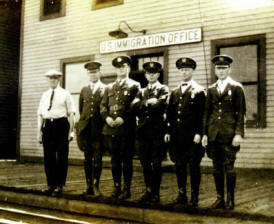
Immigration and Naturalization Service
The United States Immigration and Naturalization Service
(INS) was a part of the United States Department of
Justice and handled legal and illegal immigration and
naturalization. It ceased to exist on March 1, 2003.
Most of its functions were transferred to three new
agencies within the newly created Department of Homeland
Security in March 2003. The administration of
immigration services, including permanent residence,
naturalization, asylum, and other functions became the
responsibility of the Bureau of Citizenship and
Immigration Services (BCIS), which existed only for a
short time before changing to its current name, U.S.
Citizenship and Immigration Services (USCIS). The
investigative and enforcement functions (including
investigations, deportation, and intelligence) were
combined with U.S. Customs investigators, the Federal
Protective Service, and the Federal Air Marshal Service,
to create U.S. Immigration and Customs Enforcement
(ICE). The border functions of the INS, which included
the Border Patrol along with INS Inspectors, were
combined with U.S. Customs Inspectors into the newly
created U.S. Customs and Border Protection (CBP).
Mission
INS protected and enforced the laws of naturalization,
the process by which a foreign-born person becomes a
citizen. The INS also tackled illegal entrance into the
United States, preventing receipt of benefits such as
social security or unemployment by those ineligible to
receive them, and investigated, detained, and deported
those illegally living in the United States.
Structure
At the head of the INS was a commissioner appointed by
the president who reported to the Attorney General in
the Department of Justice. The INS worked closely with
the United Nations, the Department of State, and the
Department of Health and Human Services. The INS was a
very large and complex organization that had four main
divisions—Programs, Field Operations, Policy and
Planning, and Management—that were responsible for
operations and management.
The operational functions of the INS included the
Programs and Field Operations divisions. The Programs
division was responsible for handling all the functions
involved with enforcement and examinations, including
the arrest, detaining, and deportation of illegal
immigrants as well as controlling illegal and legal
entry. |
 |
|
|
|
|
STUDY:
The Price of Illegal Immigration on US. And the
Old Testament Price of Legal Immigration and
Sanctuary. |
|
Here's
some straight talk about the burden on the
American taxpayer caused by illegal immigration.
Pastor Joe Cortes of Faith Cometh By Hearing
ministries sheds the light on this subject
through an analysis of the "The Fiscal Burden of
Illegal Immigration on United States Taxpayers"
presented by the Federation of American
Immigration Reform or F.A.I.R.
(Read along and
download a pdf from their website here:https://fairus.org/issue/publications-resources/fiscal-burden-illegal-immigration-united-states-taxpayers
)
Pastor Cortes continues on in this study with
what the Bible has to say about immigration and
sanctuary cities. If you think the enormous cost
of illegal immigration in America is painful,
wait until you hear about the cost of legal
immigration in the Old Testament days in Israel.
OUCH!
You can see this sermon, and many more to include
categories such as:
The Last Days
The Table of
the Lord (Communion)
Discipleship
Salvation
More on the website
www.teachingfaith.com
Look for the
"Teaching Center" link.
|
|
Looking for a
good morning prayer?
Try this one.

|
|
|